How to Choose the Right Veterinary Endoscope Insertion Tube Diameter
- Share
- Issue Time
- Jul 31,2026
Summary
When choosing a veterinary endoscope, image quality, portability, and maneuverability are all important.
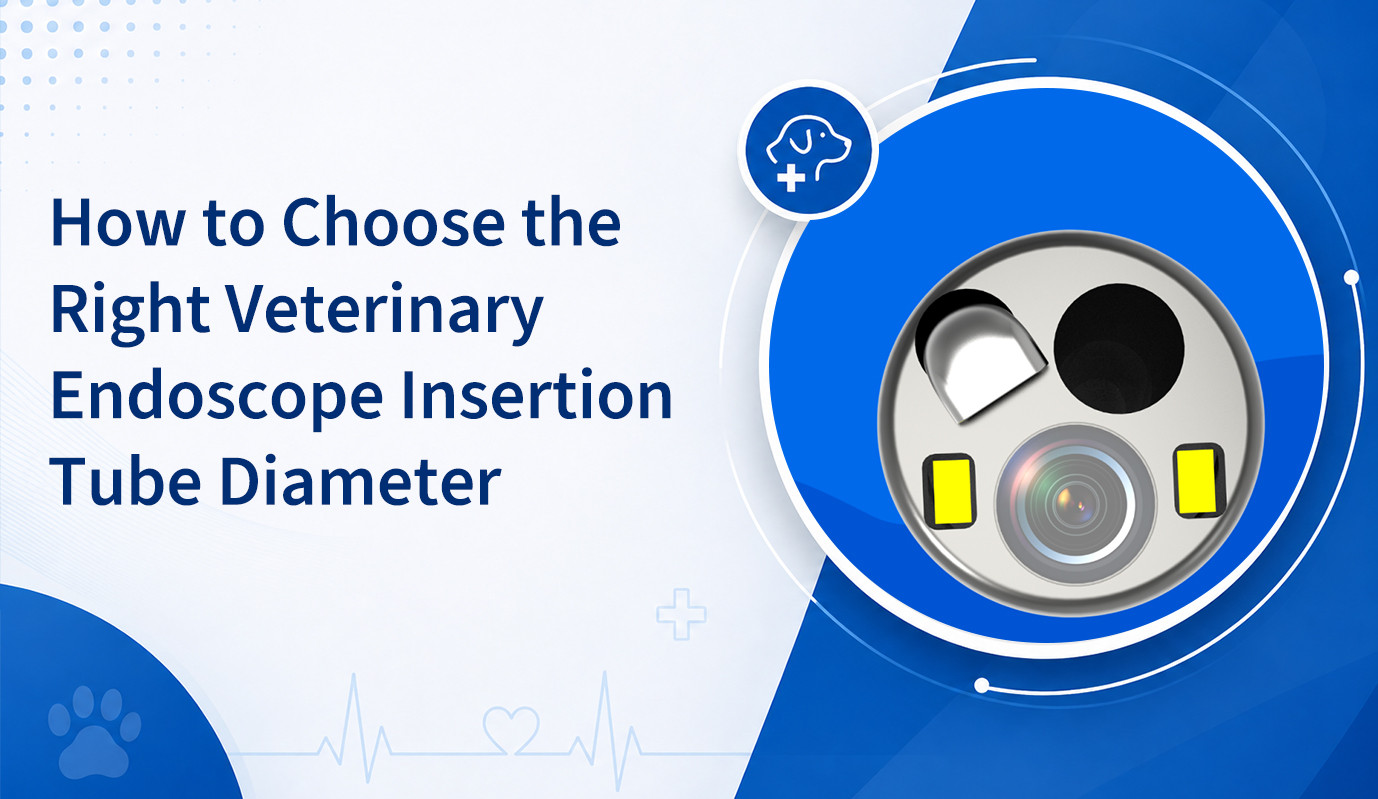
When choosing a veterinary endoscope, image quality, portability, and maneuverability are all important. However, before considering these features, veterinarians must first determine whether the endoscope can safely enter the target anatomical structure.
The insertion tube diameter is therefore one of the most important selection criteria. It directly affects which animal species and body cavities can be examined, whether endoscopic instruments can be introduced, and whether the procedure will focus primarily on diagnosis or treatment.
A Procedure Begins with “Can the Endoscope Get In?”
A pet rabbit was brought to a veterinary clinic with nasal discharge and suspected obstruction. The veterinarian initially attempted to examine the nasal cavity using a commonly available 5.8 mm flexible endoscope.
However, the distal tip could not enter the nostril. A rabbit’s nasal cavity is extremely narrow and contains complex, curved nasal turbinates, making it difficult for a standard-diameter endoscope to pass through safely.
After switching to the DZT-1616 ultra-slim rigid endoscope with a 1.6 mm insertion tube, the veterinarian was able to clearly visualize inflammation in the deeper nasal cavity.
Both devices are veterinary endoscopes, but their insertion tube diameters differ by more than four times. This difference is not simply a technical specification. It can determine whether the target anatomical structure can be accessed at all.
Why Does Insertion Tube Diameter Matter?
Before a veterinary endoscope can provide diagnostic images or support minimally invasive treatment, it must first be able to enter the target cavity safely.
Animal anatomy varies significantly. A hamster’s ear canal may measure only a few millimeters, while the esophagus of a large animal may be several centimeters wide.
Insertion tube diameter influences:
- Which animal species can be examined safely
- Access to narrow anatomical structures
- The risk of mucosal irritation or injury
- The size of the working channel
- Compatibility with biopsy and retrieval instruments
- Whether the endoscope is suitable for diagnosis, treatment, or both
The insertion tube must be smaller than the target cavity. If the diameter is too large, insertion may be impossible or may cause unnecessary trauma.
At the same time, a smaller insertion tube usually contains a smaller working channel. This limits the size of the instruments that can be introduced and may reduce the range of therapeutic procedures that can be performed.
In simple terms, choose the insertion tube diameter by first asking: Which cavity in which animal needs to be examined?
1.6 mm Ultra-Slim Rigid Endoscope for Exotic Pets and Small Animals
The DZT-1616 has an insertion tube outer diameter of only 1.6 mm. It is designed for small animals, exotic pets, and anatomical structures that cannot be accessed using conventional veterinary endoscopes.
Rabbit Nasal Cavities and Ear Canals
Rabbit nasal cavities are narrow and contain curved nasal turbinates. This makes deep examination and intubation particularly challenging. A 1.6 mm rigid endoscope can access deeper areas of the nasal cavity and ear canal while minimizing unnecessary pressure on surrounding tissues.
Parrot and Avian Airways
Birds have narrow tracheas supported by complete cartilaginous rings. Conventional intubation can be difficult and may carry a risk of airway injury. The DZT-1616 can assist with visualization and tracheal intubation in parrots, birds, rabbits, and other difficult-to-intubate exotic animals.
Hamster and Rat Urinary Tracts
The urethra and bladder of very small mammals may measure only a few millimeters. An ultra-slim veterinary endoscope may be the only practical option for entering and observing these structures.
Turtle Cloaca and Other Short Cavities
The endoscope can support examination, irrigation, and sample collection in the cloaca and other relatively short, straight anatomical passages.
Small-Animal Joint Examination
Ultra-slim rigid endoscopes may also support minimally invasive observation of small-animal joints, including the hip region and stifle joint capsule.
Key insight: The value of an ultra-slim veterinary endoscope is its ability to visualize areas that were previously inaccessible.
The DZT-1616 has a working channel of approximately 0.4 mm. It is primarily suitable for visualization, irrigation, and sample collection. It is not intended for introducing large foreign-body forceps or performing complex extraction procedures.
Its primary clinical value is visualization. It opens new possibilities for minimally invasive diagnosis in exotic pets and very small animals.
5.8 mm Standard Flexible Endoscope for Cats and Dogs
The RAE-105 veterinary flexible endoscope has an insertion tube outer diameter of 5.8 mm. It is designed for routine diagnostic and therapeutic procedures in cats, dogs, and other small to medium-sized companion animals.
Esophagus, Stomach, and Duodenum
The gastrointestinal tract of most cats and dogs provides sufficient space for a 5.8 mm insertion tube. The RAE-105 also features a 2.0 mm working channel, allowing veterinarians to introduce commonly used endoscopic instruments.
Compatible procedures may include:
- Foreign-body retrieval
- Targeted biopsy
- Retrieval basket procedures
- Cytology sampling
- Irrigation and suction
This makes it possible to identify and remove certain foreign bodies during the same minimally invasive procedure.
Trachea and Bronchi
With air and water delivery functions, the endoscope can support airway examination, lavage, fluid collection, and sampling in suitable patients.
Routine Companion-Animal Applications
A 5.8 mm flexible endoscope can cover a large proportion of routine cases involving cats and dogs. For this reason, it is often selected as a primary endoscope for veterinary clinics and animal hospitals.
Key insight: A 5.8 mm insertion tube offers an effective balance between accessibility and therapeutic capability.
It is compact enough to pass through many common companion-animal anatomical structures while providing a working channel large enough for biopsy forceps, foreign-body forceps, retrieval baskets, and other instruments.
This balance between “getting in” and “performing treatment” is why the 5.8 mm size has become a practical workhorse for many veterinary practices.
A Complete Diameter Range, Not a Single Choice
Veterinary endoscope selection is not simply a choice between a small endoscope and a large endoscope. Different animals, anatomical structures, and clinical procedures require different insertion tube configurations.
JeetVet offers veterinary endoscope solutions covering insertion tube diameters from 1.6 mm to 8.5 mm, supporting a wide range of companion-animal, exotic-animal, and large-animal applications.
| Insertion Tube Diameter | Typical Animals | Typical Applications | Primary Purpose |
|---|---|---|---|
| 1.6–2.3 mm | Birds, rabbits, rodents, reptiles, exotic pets | Nasal cavity, ear canal, airway, urinary tract, cloaca, small joints | Visualization, irrigation, sampling |
| 2.8–5.8 mm | Cats, small dogs, medium-sized dogs | Gastrointestinal tract, respiratory tract, biopsy, foreign-body retrieval | Diagnosis and treatment |
| 8.5 mm | Large dogs and large animals | Wide anatomical cavities and procedures requiring larger instruments | Advanced therapeutic procedures |
The general principle is clear:
- Smaller insertion tube diameter: More suitable for small animals, narrow cavities, and visualization-focused procedures.
- Larger insertion tube diameter: More suitable for larger animals, wider cavities, and treatment-focused procedures requiring larger instruments.
Three Questions to Ask Before Selecting a Veterinary Endoscope
1. What Type of Animal Will Be Examined?
- Exotic pets and very small animals: 1.6–2.3 mm
- Cats and dogs: 2.8–5.8 mm
- Large animals: approximately 8.5 mm, depending on the procedure
Clinics that frequently treat birds, rabbits, rodents, reptiles, or other exotic pets should prioritize access to narrow anatomical structures.
Practices focusing primarily on cats and dogs may benefit from a medium-diameter endoscope that balances access with a functional working channel.
2. Which Anatomical Structure Will Be Examined?
For short and relatively straight anatomical passages, such as the ear canal, urethra, bladder, or certain joints, a rigid veterinary endoscope may be more suitable.
For long, curved, or flexible anatomical pathways, such as the esophagus, stomach, intestine, trachea, or bronchi, a flexible veterinary endoscope is generally the more practical option.
3. Is the Procedure Diagnostic or Therapeutic?
For visualization, irrigation, or basic sample collection, an ultra-slim endoscope may be sufficient.
For procedures requiring foreign-body forceps, biopsy forceps, retrieval baskets, or other endoscopic instruments, select a model with an appropriately sized working channel.
For example, a 5.8 mm veterinary endoscope with a 2.0 mm working channel provides greater therapeutic capability than an ultra-slim endoscope with a 0.4 mm channel.
How JeetVet Supports Different Clinical Needs
JeetVet provides veterinary endoscope solutions for companion animals, exotic pets, and large-animal applications. The product range includes ultra-slim rigid endoscopes and flexible endoscopes with different insertion tube diameters and working-channel configurations.
By matching the endoscope to the animal’s size, target anatomical structure, and intended procedure, veterinary professionals can improve accessibility, reduce unnecessary tissue trauma, and expand their minimally invasive diagnostic and treatment capabilities.
From narrow nasal cavities and exotic-animal airways to gastrointestinal examinations and foreign-body retrieval in cats and dogs, each endoscope diameter serves a different clinical purpose.
Conclusion
Choosing the correct insertion tube diameter is one of the most important steps when selecting a veterinary endoscope.
The right diameter improves access to the target anatomical structure, supports safer procedures, and helps veterinarians achieve the appropriate balance between diagnostic visualization and therapeutic capability.
From 1.6 mm to 8.5 mm, the difference is more than a number. It reflects the different anatomical dimensions and clinical requirements of each animal.
Precision veterinary diagnosis begins with choosing an endoscope that can safely get in.