Veterinary Endoscope for Foreign Body Removal: A Practical Guide for Dogs and Cats
- Share
- Issue Time
- Oct 9,2026
Summary
Dogs and cats are naturally curious, and they may swallow objects that are not intended to be eaten.
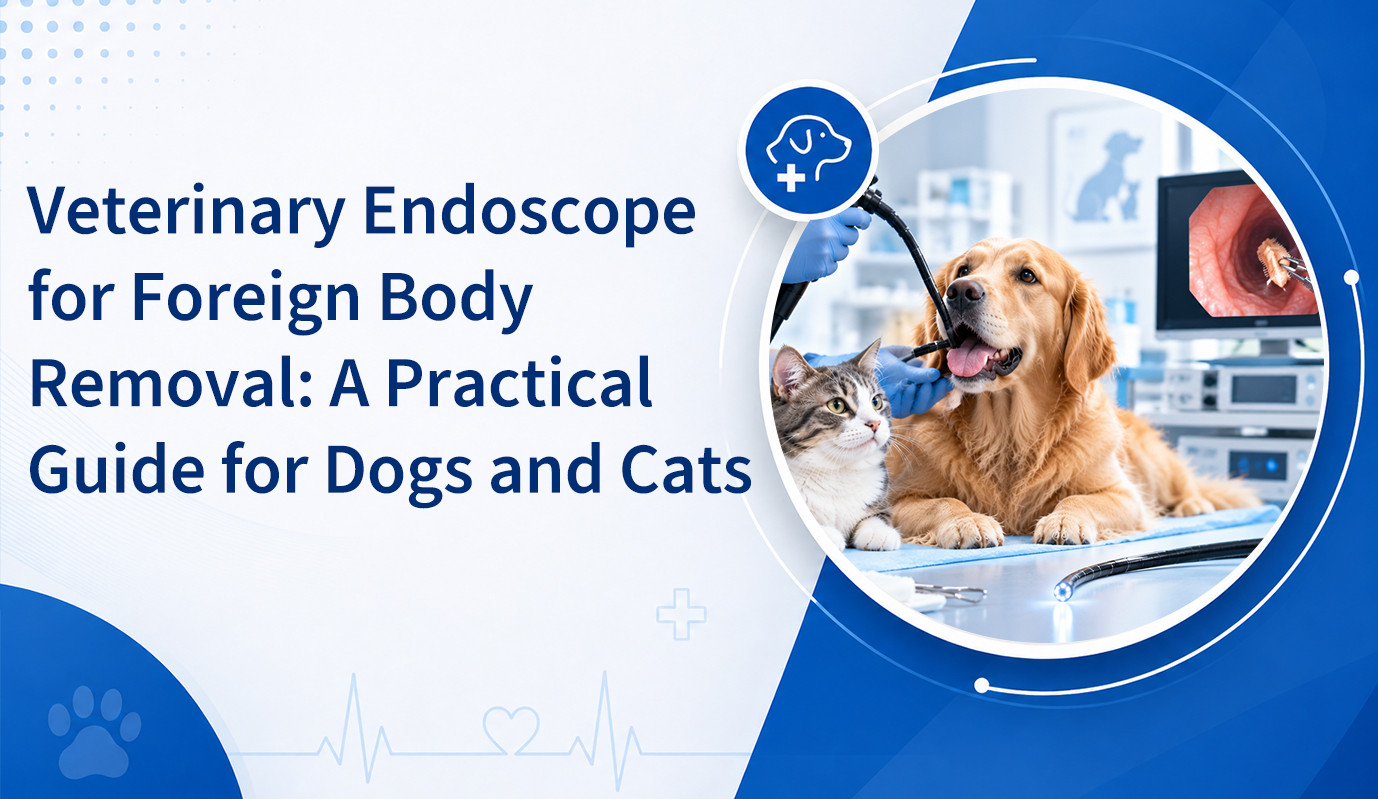
Dogs and cats are naturally curious, and they may swallow objects that are not intended to be eaten. Toys, pieces of rubber, fabric, bones, food-related objects, and other foreign materials can become lodged in the gastrointestinal tract and require veterinary evaluation.
When a swallowed object is located in an area accessible by endoscopy, a veterinary endoscope may help veterinarians examine the affected area and determine whether endoscopic retrieval is appropriate. In selected cases, endoscopic removal can provide a minimally invasive alternative to surgical extraction.
However, not every foreign body can be removed endoscopically. The object's location, size, shape, material, and relationship to surrounding tissues all influence the treatment plan.
This guide explains how veterinary endoscopy supports foreign body evaluation and removal in dogs and cats, what equipment features matter, and how veterinary clinics can select an appropriate endoscope for their clinical workflow.
What Is Veterinary Endoscopic Foreign Body Removal?
Veterinary endoscopic foreign body removal is a procedure in which a veterinarian uses an endoscope to visualize an internal passage and, when appropriate, retrieve an object with compatible endoscopic instruments.
A flexible veterinary endoscope typically combines an insertion tube, an imaging system, illumination, and—depending on the model—a working channel for compatible instruments.
During a suitable procedure, the veterinarian can use direct visualization to:
- Locate the foreign material.
- Assess its position and visible characteristics.
- Evaluate accessible surrounding mucosal surfaces.
- Determine whether retrieval appears technically feasible.
- Guide compatible retrieval instruments when the equipment and clinical situation permit.
- Inspect the accessible area after removal.
The purpose is not simply to remove an object. It is to support a controlled, clinically appropriate procedure while allowing the veterinarian to assess the surrounding tissues.
When Might a Dog or Cat Need Endoscopic Examination?
A veterinarian may investigate possible foreign body ingestion when a pet develops signs such as vomiting, reduced appetite, abdominal discomfort, lethargy, or other unexplained gastrointestinal symptoms.
These signs are not specific to foreign body ingestion, and their severity can vary. A veterinary examination is necessary to determine the likely cause and urgency.
Depending on the history and physical examination, diagnostic evaluation may include radiography, ultrasound where clinically indicated, laboratory testing, or endoscopy. The choice depends on the suspected object, its location, the patient's condition, and the information needed to make a treatment decision.
A veterinary endoscope for foreign body removal may be considered when the object is accessible through an appropriate endoscopic route and the veterinarian determines that retrieval is a suitable option.
Which Foreign Bodies May Be Suitable for Endoscopic Retrieval?
The suitability of endoscopic removal depends on more than the type of object. Its dimensions, shape, surface, position, and potential to injure tissue must all be considered.
Examples of objects that may be evaluated for endoscopic retrieval include:
- Selected swallowed toys or toy fragments.
- Rubber or plastic objects.
- Pieces of fabric or other soft materials.
- Some food-related foreign objects.
- Selected objects located in the esophagus or stomach.
These are examples of objects that may warrant evaluation, not a guarantee that they can be removed endoscopically. Sharp objects, hooked materials, large objects, and objects that are firmly lodged may present additional risks and require a different approach.
Objects located beyond the reach of the selected endoscope may also require other treatment methods.
How a Veterinary Endoscope Supports Foreign Body Removal
1. Locating the Object
Direct visualization can help the veterinarian identify an object within the accessible portion of the gastrointestinal tract. Its position and orientation may influence the choice of retrieval technique.
2. Evaluating the Surrounding Tissue
The veterinarian can examine visible mucosal surfaces for abnormalities such as irritation, abrasions, bleeding, or swelling. Endoscopy cannot rule out every type of tissue injury, so additional assessment may be needed when complications are suspected.
3. Guiding Compatible Retrieval Instruments
If removal is appropriate, compatible forceps or other retrieval accessories may be introduced through the working channel of a suitable endoscope. The veterinarian selects the instrument and technique according to the object and procedural requirements.
4. Reassessing the Accessible Area
Following retrieval, the veterinarian can inspect the accessible area for visible residual material or tissue changes. Further imaging, monitoring, or intervention may be required depending on the findings.
Why the Working Channel Matters
The working channel is an important consideration when selecting a veterinary endoscope for foreign body retrieval.
It provides a pathway for compatible instruments to reach the examination area while the veterinarian maintains endoscopic visualization.
Before selecting an endoscope, clinics should evaluate:
- Channel diameter: Must accommodate the intended compatible instrument.
- Instrument compatibility: The retrieval accessory must match the endoscope's specifications.
- Working length: The instrument must reach the target area through the endoscope.
- Tip control: The endoscope should provide appropriate directional control for the intended procedure.
- Cleaning requirements: The channel must be reprocessed according to the manufacturer's instructions.
A larger working channel is not automatically better. The appropriate configuration is the one that balances instrument compatibility, insertion tube dimensions, reach, and the intended clinical application.
Choosing the Right Insertion Tube Diameter
The insertion tube diameter influences which anatomical pathways a veterinary endoscope can access. Dogs and cats vary considerably in body size, and the appropriate diameter also depends on the intended route and procedure.
When evaluating an endoscope for foreign body procedures, consider:
- The species and size of the patient.
- The suspected location of the object.
- The diameter appropriate for the intended anatomical pathway.
- Whether the procedure requires a working channel.
- The retrieval accessories that may be needed.
Choosing a scope based on diameter alone may overlook important limitations. The complete configuration must be suitable for both the patient's anatomy and the planned procedure.
Why Working Length and Maneuverability Matter
Working length determines the reach available for a particular examination. Maneuverability and distal tip control influence how the veterinarian directs the viewing field and positions compatible instruments.
For gastrointestinal foreign body procedures, these features should be evaluated together:
- Working length: Appropriate for the intended anatomical target.
- Flexibility: Suitable for navigating the planned route.
- Tip articulation: Supports directional control within the device's specified range.
- Image stability: Helps maintain a useful view during examination.
- Instrument passage: Supports the compatible accessories required for the procedure.
Good maneuverability can support procedural control, but it does not make every foreign body accessible or safe to retrieve endoscopically.
Image Quality and Foreign Body Visualization
Clear visualization is central to endoscopic examination. The veterinarian needs to distinguish the foreign object from surrounding tissue and assess the visible area during the procedure.
Image quality depends on several factors, including:
- Resolution and image detail.
- Illumination.
- Color reproduction.
- Field of view.
- Working distance.
- Image stability during movement.
Resolution alone does not determine clinical performance. A well-balanced imaging system should provide a clear and usable view under the conditions expected during the intended examination.
Endoscopy or Surgery: How Is the Decision Made?
Endoscopic retrieval and surgery are different treatment approaches. The appropriate choice depends on the patient's condition and the characteristics of the foreign body.
| Clinical Consideration | Why It Matters |
|---|---|
| Object location | Determines whether the object can be reached with the proposed endoscopic approach. |
| Object size and shape | Affects whether the object can pass safely through the intended route during retrieval. |
| Object material | Influences grasping, manipulation, and the risk of fragmentation or injury. |
| Potential tissue injury | Suspected perforation or significant damage may require a different treatment strategy. |
| Patient stability | Helps determine the urgency, preparation, and suitability of the procedure. |
| Available equipment and expertise | Influences the range of safe and practical treatment options. |
In selected cases, endoscopic removal may avoid the need for an open surgical approach. In other situations, surgery or another intervention may be more appropriate. The veterinarian should determine the treatment plan after evaluating the individual patient.
What Are the Limitations of Endoscopic Foreign Body Removal?
Although a veterinary endoscope can provide useful visualization and access, endoscopic retrieval has limitations.
Potential challenges include:
- Foreign bodies located beyond the reach of the endoscope.
- Objects that are too large to pass safely through the retrieval route.
- Sharp, hooked, or irregular objects that may injure tissue.
- Objects that are firmly embedded or difficult to grasp.
- Suspected perforation or serious gastrointestinal damage.
- Limited access or inadequate visualization.
The veterinarian should also consider whether the procedure can be performed with appropriate monitoring, anesthesia or sedation when indicated, and suitable equipment. If endoscopic retrieval is unsuccessful or judged unsafe, an alternative treatment plan may be necessary.
What Happens After Endoscopic Retrieval?
Removal of a foreign body does not necessarily conclude the clinical assessment.
After the procedure, the veterinary team may need to consider:
- Inspection of the accessible tissue for visible injury.
- Monitoring for persistent or recurring clinical signs.
- Additional imaging or testing if complications are suspected.
- Appropriate recovery monitoring and follow-up.
- Dietary or activity instructions based on the veterinarian's findings.
Recovery and follow-up depend on the object, the location, the duration of impaction, the condition of the gastrointestinal tract, and the procedure performed.
How JeetVet Supports Veterinary Endoscopy
JeetVet develops veterinary endoscope solutions for diagnostic and clinical applications in animal healthcare.
The RAE-105 Portable USB Veterinary Endoscope is one of JeetVet's portable systems, with applications that include gastrointestinal examination and selected foreign body removal procedures. Its suitability for a specific case depends on the patient's anatomy, the location and characteristics of the object, compatible accessories, and the veterinarian's clinical assessment.
When evaluating a veterinary endoscope for foreign body management, clinics should look beyond portability or image resolution alone. Insertion tube diameter, working length, working channel compatibility, tip control, imaging performance, and reprocessing requirements all contribute to the overall suitability of the system.
The goal is to match the equipment to the procedure rather than assume that one endoscope can meet every clinical requirement.
Frequently Asked Questions
Can a veterinary endoscope remove foreign bodies from dogs?
In selected cases, a veterinarian may use an endoscope to retrieve an object that is accessible and suitable for endoscopic removal. The decision depends on the object's characteristics, location, and the patient's condition.
Can a veterinary endoscope remove foreign bodies from cats?
Endoscopic retrieval may be an option for some cats, but suitability depends on the patient's size, the anatomical location, the object, and the equipment available.
Does foreign body removal require a working channel?
Instrument-assisted retrieval generally requires an appropriate working channel and compatible instruments. The exact equipment depends on the planned procedure and the endoscope design.
Can every swallowed object be removed endoscopically?
No. Some objects are inaccessible or may pose unacceptable risks during retrieval. Surgery or another treatment may be necessary, depending on the clinical findings.
What should a clinic consider when buying a veterinary endoscope for foreign body retrieval?
Key considerations include insertion tube diameter, working length, image quality, tip articulation, working channel dimensions, accessory compatibility, reprocessing requirements, and the procedures the clinic expects to perform.
Conclusion
A veterinary endoscope can play an important role in evaluating gastrointestinal foreign bodies and supporting retrieval in selected dogs and cats.
Direct visualization helps veterinarians locate objects, assess accessible tissue, and guide compatible instruments when endoscopic removal is clinically appropriate. However, successful and safe treatment depends on the characteristics of the object, its location, the patient's condition, and the capabilities of the equipment.
For veterinary clinics, choosing an appropriate endoscope means balancing insertion tube diameter, working length, image quality, maneuverability, and working channel compatibility. When these factors align with the clinical application, veterinary endoscopy can provide a valuable option within a broader, patient-specific diagnostic and treatment plan.